
Diopter vs. Magnification: What’s the Difference in Reading Glasses?
If you’ve ever looked at reading glasses labeled +1.00, +2.50, or +4.00, you may have wondered:
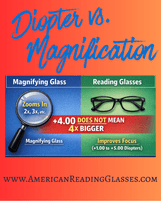
Does +4.00 mean things look four times bigger?
It’s one of the most common questions we hear — and the answer might surprise you.
Let’s break it down in simple terms.
What Is a Diopter?
A diopter (D) is the scientific measurement used to describe the focusing power of a lens.
When reading glasses are labeled:
-
+1.00
-
+2.00
-
+3.50
-
+4.00
-
+5.00
Those numbers represent diopter strength, not magnification level.
The higher the number, the more focusing assistance the lens provides for near work.
Eye doctors use diopters when writing prescriptions, and over-the-counter reading glasses use the same measurement system.
Does +4.00 Mean 4× Magnification?
No.
Reading glasses do not magnify text the way a magnifying glass does.
A magnifier might say “2×” or “3×,” which means the image is physically enlarged by that factor.
Reading glasses work differently.
Instead of enlarging the image, they:
-
Shift the focal point closer
-
Help your eyes focus on nearby objects
-
Reduce strain caused by presbyopia (age-related near vision changes)
So while higher strengths may feel stronger, they are improving focus — not multiplying size.
Why It Feels Like Magnification
Many people describe high-strength readers as “strong magnification” because:
-
Small print becomes sharp and clear
-
Contrast improves
-
Eye strain decreases
When your eyes are no longer struggling to focus, clarity increases dramatically — and that can feel like enlargement.
But technically speaking, it’s focus correction, not image enlargement.
Are Diopter and Magnification the Same Thing?
In everyday conversation, people often use the words diopter and magnification to mean roughly the same thing — how strong the reading glasses feel.
Technically, they are not identical. A diopter is the scientific measurement of lens focusing power, while magnification usually refers to image enlargement.
However, when shopping for reading glasses, both terms are commonly used to describe lens strength. Higher diopter numbers are often referred to as higher “magnification” because they provide stronger near-focus support.
The important thing to remember is that reading glasses improve focus and clarity rather than enlarging images by a specific multiple.
Why This Matters When Choosing Strength
Understanding this difference helps you:
-
Avoid choosing a strength that’s too strong
-
Set realistic expectations
-
Reduce eye fatigue
-
Minimize returns due to confusion
For example:
If you need help reading medication labels or very small print, a higher strength like +4.00 diopters may help you focus more comfortably — but it will not make text “four times bigger.”
High-Magnification Reading Glasses Explained
In everyday language, people use the phrase “high magnification reading glasses.”
In the optical world, that simply refers to higher diopter strengths, typically:
-
+3.50
-
+4.00
-
+4.50
-
+5.00 and above
These strengths provide stronger near-focus assistance and are often helpful for:
-
Very small print
-
Detailed craftwork
-
Low vision needs
-
Close-up hobby work
If you’re looking for stronger options, you can explore our full selection of high magnification reading glasses here:
https://www.americanreadingglasses.com/reading-glasses/high-magnification/
The Simple Way to Remember It
Here’s an easy comparison:
-
Magnifying glass = zoom
-
Reading glasses = focus adjustment
It’s more like adjusting the focus on a camera than zooming in.
Frequently Asked Question
What does the “+” number on reading glasses mean?
The “+” number represents diopter strength, which measures how strongly the lenses help your eyes focus on close objects. Higher numbers provide stronger near-focus assistance but do not enlarge images by a specific multiple.
Final Thoughts
If you’ve ever been confused by the terms diopter and magnification, you’re not alone.
The most important thing to remember is this:
Reading glasses improve clarity and comfort at close distances.
They do not multiply image size.
Choosing the correct strength is about finding the level of focus your eyes need — not choosing a zoom factor.
If you’re unsure which strength is right for you, start with a printable strength chart or consider ordering multiple strengths to compare at home.
Clear vision starts with understanding how your lenses work.